
PyTorch Tutorial 13 - Feed-Forward Ne...
教程Python代码如下:
# MNIST
# DataLoader, Transformation
# Multilayer Neural Net, activation function
# Loss and Optimizer
# Training loop (batch training, 批处理训练)
# Model evaluation
# GPU support
"""进行数字分类的多层神经网络,基于著名的MNIST数据集"""
import torch
import torch.nn as nn
import torchvision
import torchvision.transforms as transforms
import matplotlib.pyplot as plt
# Device configuration
device = torch.device('cuda' if torch.cuda.is_available() else 'cpu')
# hyper parameters, 超参数
input_size = 784 # 28*28, 图像的大小是28*28,拉伸至一维是784
hidden_size = 100
num_classes = 10 # 0-9共10个数字
num_epochs = 2
batch_size = 100
learning_rate = 0.001 # 学习速率
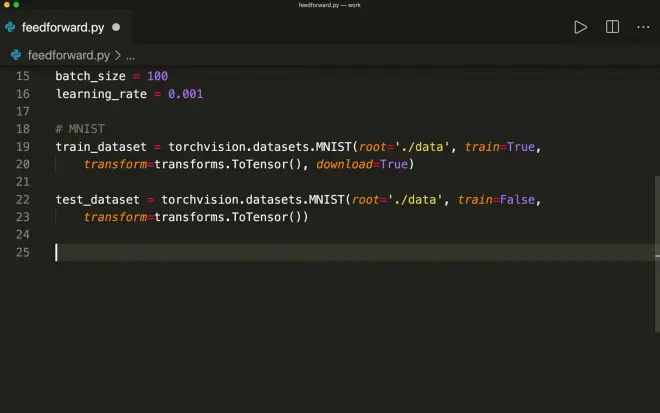
#MNIST
train_datasets = torchvision.datasets.MNIST(root='./Data', train=True, transform=transforms.ToTensor(), download=True)
test_datasets = torchvision.datasets.MNIST(root='./Data', train=False, transform=transforms.ToTensor())
train_loader = torch.utils.data.DataLoader(dataset=train_datasets, batch_size=batch_size, shuffle=True)
test_loader = torch.utils.data.DataLoader(dataset=test_datasets, batch_size=batch_size, shuffle=False)
"""examples = iter(train_loader)
samples, labels = examples.next()"""
examples = iter(test_loader)
samples, labels = next(examples)
print(samples.shape, labels.shape)
for i in range(6):
plt.subplot(2, 3, i+1)
plt.imshow(samples[i][0], cmap='gray')
#plt.show()
# Fully connected neural network with one hidden layer
class NeuralNet(nn.Module):
def __init__(self, input_size, hidden_size, num_classes):
super(NeuralNet, self).__init__()
self.input_size = input_size
self.l1 = nn.Linear(input_size, hidden_size)
self.relu = nn.ReLU()
self.l2 = nn.Linear(hidden_size, num_classes)
def forward(self, x):
out = self.l1(x)
out = self.relu(out)
out = self.l2(out)
# no activation and no softmax at the end
return out
model = NeuralNet(input_size, hidden_size, num_classes).to(device)
# Loss and optimizer
criterion = nn.CrossEntropyLoss()
optimizer = torch.optim.Adam(model.parameters(), lr=learning_rate)
# Train the model
n_total_steps = len(train_loader)
for epoch in range(num_epochs):
for i, (images, labels) in enumerate(train_loader):
# origin shape: [100, 1, 28, 28]
# resized: [100, 784]
images = images.reshape(-1, 28 * 28).to(device)
labels = labels.to(device)
# Forward pass
outputs = model(images)
loss = criterion(outputs, labels)
# Backward and optimize
optimizer.zero_grad()
loss.backward()
optimizer.step()
if (i + 1) % 100 == 0:
print(f'Epoch [{epoch + 1}/{num_epochs}], Step [{i + 1}/{n_total_steps}], Loss: {loss.item():.4f}')
# Test the model
# In test phase, we don't need to compute gradients (for memory efficiency)
with torch.no_grad():
n_correct = 0
n_samples = 0
for images, labels in test_loader:
images = images.reshape(-1, 28 * 28).to(device)
labels = labels.to(device)
outputs = model(images)
# max returns (value ,index)
_, predicted = torch.max(outputs.data, 1)
n_samples += labels.size(0)
n_correct += (predicted == labels).sum().item()
acc = 100.0 * n_correct / n_samples
print(f'Accuracy of the network on the 10000 test images: {acc} %')
