
试译 | A面作品1954-1963——海杜克《美杜莎的面具》
Museum 1 begins Frame 2 (1954) and Museum 2 completes Frame 2 (1963). The museums had to do with the structural infilling of space, Museum 1 along the horizontal plan (from periphery columns to central walls); in Museum 2 the structural infilling of space formed along the vertical section. In both cases a structural densification of space takes place confronting the idea of the diminutive cycle. Museum 1 developed the idea of the concentric diminishing square, the periphery edge structured with columns, then a gradual doubling of columns until the columns became walls. It also developed the idea of the space between the columns (following the concept of complete openness to complete closeness; from open air, to clear glass, to translucent glass, to opaque glass to … ). Museums confront the emptiness of space . . . the voidness of space. Museums are the sacred coffins of art. I can hardly imagine being in any museum alone.
Parallel to the Texas House work (Section B) a series of other projects were produced. One series was the study for wood frame houses. The other series was called “Piano” House or “Variations on a Theme.” The “Piano” Houses were done in steel, reinforced concrete, masonry, stucco and plaster. They ranged from single storey structures to three storey structures. The study of the syncopation of the three storey house facades was of prime interest. The spatial play of the geometric window openings in the facade-plane positioned against the cell-frame structure (implied structure), produced the counterpoint. The slippage of planes, the movement upon the frame of time were the essential cerebral issues, and also the visual ones.
The house facade studies were carried over into an intense investigation of a six storey apartment block. The floor plans of the apartments related to the setting up of the window placements upon the four exterior elevations (as notes in music). The apartment plan was a very complex system, very difficult. I was working into a deep square field in order to capture and relate to the peripheric elevations. As in the early researches into Texas House 3 in the plans and elevations here in the apartment house facades were the first probes into De Stijl-Mondrain musical notations.
During this period two designs investigating large span structures were undertaken, one an Airplane Hanger, the other a Factory. Regarding the Factory Program (one of the most difficult programmatic problems), the question was “How to combine a program that contains large span (column free) spaces (singular space), with a multitude of smaller office spaces?” There was an attempt to establish some kind of prototype. The front elevation of the Factory office element again addressed the idea of structural frame counter pointing to a symmetrical-asymmetrical rhythm of window openings, playing on the frame of time, completing a cycle (as in the Row House study sketches).
The years 1954-1963 were primarily a monochromatic period; practically no color was used. It was purposefully dry, sparse, hard, reductive; a search for certain essences. It should be pointed out that when the Texas House series was commenced in 1954, there was a plan to spend ten years on that particular study, hoping to complete one house per year. The Texas House studies were terminated in 1963 after having worked on seven houses. Suddenly a shift occurred , a shift in the path and the Diamond Projects appeared.
以下为尝试翻译稿,请谨慎阅读。如有误导,概不负责。

第二部分的研究从博物馆1号开始(1954年)到博物馆2号结束(1963年)。这两个博物馆研究的是空间的结构引入,博物馆1号结构沿平面布置(从外围柱到中心墙体),博物馆2号的空间结构引入则沿垂直剖面生成。在这两个方案中,面对“微小循环”的概念都产生了一种结构致密化的空间。博物馆1号发展出“同心递减方阵”的概念,外围边界由柱子构成,然后逐渐将柱子翻倍直到形成墙壁。同时也发展了“柱间空间”的概念(遵循从完全开放到完全封闭的概念;从了无遮挡,到透明,半透,直到完全不透......)。博物馆遭遇了空间的虚无...空间的失效。博物馆是艺术的神圣棺椁,我很难想象独自一人待在任何一座博物馆里。

博物馆1平面


平行于德克萨斯住宅的研究(B面),一系列其他项目被建造。其中一个系列是木框架房屋的研究。另外一些则是所谓的“钢琴住宅”,或称“变奏主题”。“钢琴住宅”由钢材、混凝土、砖石、灰泥和石膏建造。它们从单层结构到三层结构不等。其中三层住宅外立面切分音研究是最有意义的。外立面几何形窗格与结构框架单元(隐性结构)对应布置的空间操作,形成了一种对位关系。立面表皮沿时间框架的滑移既是基本的理性问题,同时也是视觉问题。


建筑外立面研究被带到对一栋六层公寓大楼的深入研究。公寓楼各层楼平面与四个外立面上窗户位置的设置关联(如同音乐中的音符)。这个公寓楼平面是一个非常复杂的系统,相当有难度。我在一个很深的方形区域里进行操作,以俘获和关联到外立面。正如早期德克萨斯住宅3号的平面和立面研究一样,这栋公寓楼住宅的外立面是对风格派蒙德里安“音符”的第一次探讨。

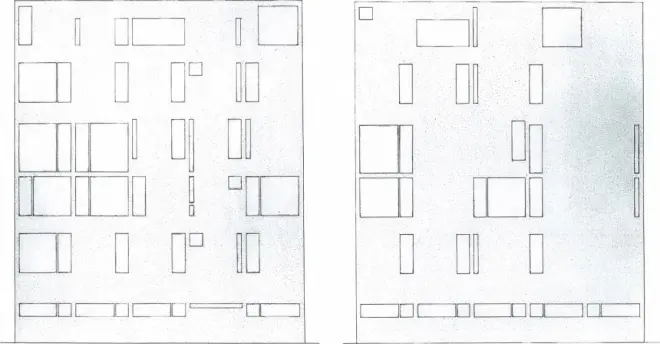


在这期间,曾进行过两个研究大跨度结构的设计,一个是飞机库设计,另一个是工厂设计。关于工厂的项目(最难的项目难题之一),其问题在于“怎么协调(单一、无柱)大空间与一系列的小的办公空间?”有尝试建立一些原型。工厂办公单元正立面再次强调了将结构框架与对称-非对称的开窗韵律相对位的概念,在时间框架上进行“演奏”,完成一个循环(就像联排住宅研究草图里那样)。


联排住宅草图
1954-1963年基本上是一段以单色进行研究的时期,几乎没有使用任何颜色。这段研究有意地干涩、孤立、深入、还原,探寻某种特定的本质。需要指出的是,当德克萨斯住宅研究于1954年开始的时候,有一个计划是花十年时间进行这项专题研究,并希望每年完成一个住宅。但德克萨斯住宅研究在完成了七所房子之后于1963年终止了。方向突然发生了转变,菱形住宅项目开始出现。
本篇英文原稿及插图来自于Mask of Medusa,by John Hejduk;
