
【简译】拜占庭的斐洛与《世界七大奇迹》

Philo of Byzantium's on the Seven Wonders (225 BCE) is the first known list of the Seven Wonders of the Ancient World (though it may have been based on earlier works now lost). Philo's list differs from the standard Seven Wonders in replacing the Lighthouse at Alexandria with the Walls of Babylon.
拜占庭的斐洛(Philo of Byzantium)所著的《世界七大奇迹》(Επτά θαύματα του αρχαίου κόσμου,公元前225年)是第一份已知的古代世界七大奇迹清单(尽管它可能是基于现已失传的更早的作品)。斐洛的清单与标准的七大奇迹不同,他用巴比伦城墙取代了亚历山大灯塔。
There were several lists, or references to, the Seven Wonders in antiquity by writers including Herodotus, Antipater of Sidon, Callimachus of Cyrene, Strabo, and Diodorus Siculus. Diodorus (l. 1st century BCE), in his Bibliotheca historica ("Historical Library") provides the standard list recognized today:
The Great Pyramid of Giza, Egypt
The Hanging Gardens of Babylon
The Statue of Zeus at Olympia, Greece
The Temple of Artemis at Ephesus
The Mausoleum at Halicarnassus, Caria
The Colossus of Rhodes
The Lighthouse of Alexandria, Egypt
希罗多德、西顿的安提帕特、昔兰尼的卡利马科斯、斯特拉波和狄奥多罗斯 ·西库鲁斯等作家曾多次列举或提及古代七大奇迹。狄奥多罗斯(公元前 1 世纪左右)在他的《历史丛书》(Bibliotheca historica)中为我们提供了今天公认的标准:
埃及吉萨大金字塔
巴比伦空中花园
希腊奥林匹亚宙斯神像
以弗所的阿耳忒弥斯神庙
哈利卡那索斯的摩索拉斯王陵墓
罗得岛太阳神铜像
埃及亚历山大灯塔
Philo includes all of these except the Lighthouse of Alexandria, choosing instead the Walls of Babylon, perhaps because he lived in the city and worked at the Library of Alexandria and so, maybe, he was simply used to seeing the lighthouse which was completed under Ptolemy II Philadelphus (r. 282-246 BCE), though this is speculation. There does not seem to need to be any reason for one writer choosing a given Wonder over another other than personal taste, and any list or reference to the Seven Wonders includes sites on par with those on the list recognized today. Callimachus of Cyrene (l. c. 310 to c. 240), for example, chose to include the Ishtar Gate of Babylon among the Wonders, and many who have seen the rebuilt gate at the Pergamon Museum in Germany would most likely agree with him.
除了亚历山大灯塔,斐洛都提及到这些奇迹,他选择用巴比伦城墙代之,这也许是因为他住在亚历山大城,并在亚历山大图书馆工作,且在托勒密二世·费拉德尔菲斯统治时期(公元前 282-246 年)竣工后,他与之朝夕相处。除了个人喜好之外,一位作家选择某一奇观而不是另一奇观似乎不需要任何理由,任何有关七大奇观的清单或参考资料都包括与今天公认的七大奇观相同的部分。例如,昔兰尼的卡利马科斯(Callimachus of Cyrene,约 310 年至约 240 年)选择将巴比伦的伊什塔尔城门列入奇迹之列,许多在德国佩加蒙博物馆参观过重建大门的人很可能会同意他的观点。
Philo's list breaks off in the middle of his description of the Temple of Artemis at Ephesus (Chapter 6), and the rest of the manuscript is lost. It is thought the missing part included the Mausoleum at Halicarnassus because, in his introduction, he mentions how one must "go to Halicarnassus in Caria" in listing where to see the Seven Wonders (Romer, 230). The work was created in Alexandria, probably at the library, where Philo was an engineer. This is by no means certain, however, and some scholars doubt whether Philo of Byzantium is even the author of the piece, referring to whoever wrote it as "Pseudo-Philo of Byzantium." It seems, however, to have been written in Alexandria and was then taken to Byzantium where it was copied, and those copies sent to other intellectual centers of the time (Romer, x).
斐洛的清单在描述以弗所的阿耳忒弥斯神庙(第 6 章)时中途中断,手稿的其余部分已经遗失。人们认为遗失的部分包括哈利卡那索斯的摩索拉斯王陵墓,因为他在导言中提到,在列出七大奇迹的地点时,必须“前往卡里亚的哈利卡那索斯”(Romer,230)。这部作品很可能是他在亚历山大图书馆构思的,斐洛曾在那里担任工程师。然而,尚无定论,因此一些研究人员怀疑拜占庭的斐洛是否是这篇文章的作者,并将其作者称为“伪拜占庭斐洛”。尽管如此,这篇文章似乎是在亚历山大写的,然后被带到拜占庭,在那里制作了副本并发送到当时的其他知识中心(Romer, x)。
At some point, it made its way to Europe and, according to scholar Roger Pearse, was "in the hands of the printer Hieronymus Froben in Basle in Switzerland" in the 1530s (2). Prior to this, it is thought to have been consulted by the historian, monk, and scholar Bede (l. c. 673-735 CE), who compiled his own list, which, like the many others, differs from the standard. On the Seven Wonders was included in the Palatine Library of Heidelberg, Germany, in the 16th century, was part of the collection of the Vatican in the 17th century, and then was taken to Paris after the library was looted, only finding its way back to Heidelberg in the 19th century, where the manuscript is held today (Pearse, 2).
据学者罗杰·皮尔斯 (Roger Pearse) 称,该书在 15 世纪 30 年代“落入瑞士巴塞尔印刷商杰罗姆·弗罗本 (Jerome Froben)之手”(2)。在此之前,历史学家、修道士和学者贝德(Bede,约公元前 673-735 年)曾查阅过该书目,他编制了自己的书目,与许多其他书目一样,该书目与标准书目不同。《世界七大奇迹》于 16 世纪被收入德国海德堡帕拉丁图书馆,17 世纪成为梵蒂冈藏书的一部分,图书馆被洗劫后被带到巴黎,直到 19 世纪才被送回海德堡,手稿至今仍保存在那里(Pearse, 2)。
The piece is important as the first known catalog of the Seven Wonders, even if it does draw on earlier authors. Philo's obvious admiration for the works he describes, as well as what he says about traveling to see them in his introduction, leads a reader to believe he visited all seven sites personally, though this may not have been the case. Even so, the detail of his work has captured the imaginations of readers for centuries, inspiring others to create lists of their own right up through the present day.
作为第一部已知的七大奇迹目录,这部作品非常重要,尽管它确实借鉴了早期作者的作品。斐洛对他所描述的作品的钦佩之情溢于言表,加上他在引言中提到的前往游览的经历,让读者相信他曾亲自游览过这七个奇迹,尽管事实可能并非如此。即便如此,几个世纪以来,他作品中的细节还是激发了读者的想象力,至今激励着人们创建自己的奇迹清单。

奇迹清单
The following translation is by Hugh Johnstone, from the book The Seven Wonders of the World: A History of the Modern Imagination by John and Elizabeth Romer. It should be noted that Philo never places the Hanging Gardens in Babylon – he does not mention where they are – supporting the claim of modern scholars, such as Stephanie Dalley, that the Hanging Gardens were actually in Nineveh. He also chooses all of the pyramids of the Giza plateau, not just the Great Pyramid.
1.Everyone has heard of each of the Seven Wonders of the World, but few have seen all of them for themselves. To do so, one has to go abroad to Persia, cross the Euphrates River, travel to Egypt, spend some time among the Elians in Greece, go to Halicarnassus in Caria, sail to Rhodes, and see Ephesus in Ionia. Only if you travel the world and get worn out by the effort of the journey will the desire to see all the Wonders of the World be satisfied, and by the time you have done that you will be old and practically dead.
以下译文由休·约翰斯通(Hugh Johnstone)根据约翰·罗默(John Romer)和伊丽莎白·罗默(Elizabeth Romer)所著的《世界七大奇迹:历史、传说和考古研究》翻译而成。值得一提的是,斐洛从未将空中花园定位于巴比伦,这支持了斯蒂芬妮·达利(Stephanie Dalley)等现代学者的说法,即空中花园实际上在尼尼微。此外,他还选择了吉萨高地的所有金字塔,而不仅仅是大金字塔(胡夫金字塔)。
1.每个人都听说过世界七大奇迹的故事,但很少有人能亲眼看到它们的全部。要做到这一点,就必须出国去波斯,跨过幼发拉底河,到埃及旅行,在希腊的厄利斯(Elis)呆上一段时间,到卡里亚的哈利卡那索斯,乘船到罗得岛,去参观伊奥尼亚(爱奥尼亚)的以弗所。只有走遍世界,感受到旅途的疲惫,才能满足一睹七大奇迹的愿望,而当目的最终达到时,你或许已经老了,快要死了。
2.Because of this, education can perform a remarkable and valuable task: it removes the necessity to travel, displays the beautiful and amazing things in one's very own home, and allows one to see those things with one's mind if not with one's eyes. If a man goes to the different locations, sees them once, and goes away, he immediately forgets: the details of the works are not recalled, and memories of the individual features fail. But if a man investigates in verbal form the things to wonder at and the execution of their construction, and if he contemplates, as though looking at a mirror image, the whole skillful work, he keeps the impressions of each picture indelible in his mind. The reason for this is that he has seen amazing things with his mind.
2.正因如此,教育可以发挥一项非凡而有价值的任务:它避免了人们旅行的必要性,足不出户就能展示美丽而令人惊叹的事物,让人们即使不是用眼睛,也能用心灵感受这些事物。如果一个人去了不同的地方,只欣赏一次然后离开,他马上就会忘记:事物的细节想不起来了,对个别特征的记忆也失效了。但是,如果一个人以语言的形式去研究那些值得惊叹的事物及其构造,如果他像看镜像一样凝视着整个巧夺天工的作品,他就会把每个作品印象牢牢地记在脑海中。之所以如此,是因为他用心灵感受到了这些令人惊叹的奇妙场景。
3.What I say will be shown to be reliable if my words make a clear description of each of the Seven Wonders and persuade the listener to acknowledge that he has got an idea of the spectacle. Of course, only the Seven Wonders are commonly described as praiseworthy, in so far as other sights can be seen just as much as these, but the admiration for the Seven Wonders and for other sights is different. For beauty, like the sun, makes it impossible to see other things when it is itself radiant.
3. 如果我的言语对七大奇迹中的每一个都进行了清晰的描述,并说服听众认识到他已经对奇观有了相当的了解,那么我所说的可靠性就会变得显而易见。当然,在其他可见的景观中,通常只有七大奇迹才被描述为值得称赞的,但七大奇迹所引起的赞叹与其他景观不同。因为美就像太阳一样,当它本身光芒四射时,就让人无法感受到其他事物。

一、巴比伦空中花园
1.The so-called Hanging Garden with its plants above the ground grows in the air. The roots of trees form a roof over the ground. Stone pillars stand under the garden to support it and the whole area beneath the garden is occupied with engraved bases of the pillars.
1. 所谓空中花园,就是植物高出地面,向空中开放。树根形成土壤的覆盖物。花园下方矗立着支撑花园的石柱,花园下方的整个区域都被柱子的雕刻基座占据。
2.Individual beams of palm trees are in position, and the space separating them is very narrow. The wood from palm trees is the only kind of wood which does not rot. When they are saturated and under great pressure, they arch upwards and nourish the capillaries of the roots [of the vegetation] and admit into their own crevices roots that are not their own.
2. 由棕榈树干制成的独立梁放置在适当的位置,它们之间有一个狭窄的间隙。棕榈树的木材是唯一不会腐烂的木材。当它们饱和并承受巨大压力时,就会向上拱起,滋养(植物)根部的毛细血管,并将不属于自己的根部引入自己的缝隙中。
3.On top of these beams a great amount of earth is poured to quite a depth. On top grow broad-leaved trees and garden trees, and there are varied flowers of all kinds – in short, everything that is most pleasing to the eye and most enjoyable. The area is cultivated just as happens on ground level. In much the same way as on normal ground, it sees the work of people who plant shoots: ploughing goes on above those wandering through the supporting colonnade.
3. 将大量土倒在这些梁的顶部,以达到相当的厚度。上面生长着阔叶树和园林树,还有各式各样的花朵,总之,一切都让人赏心悦目、心旷神怡。该区域的栽培方式与地面栽培方式相似。与正常田地中发生的情况类似,它考虑了种植树苗的人们的工作,而栽培土地的工作则在那些在充当支撑的柱子之间徘徊的人的上方继续进行。
4.While people walk along the top, the land on top of the roof is motionless and, as in the most fertile regions, remains pure. From above, aqueducts carry in running water: along one way the stream follows a wide downhill course, along the other way the water runs up, under pressure, in a screw; the necessary mechanisms of the contraption make the water run round and round in a spiral. The water goes up into many large receptacles and irrigates the whole garden. It dampens the roots of the plants deep in the earth and keeps the earth moist. This is why the grass is always green and the leaves of the trees grow permanently [? nourished by the dew, on tender boughs.
4. 当人们在上面行走时,屋顶上方的土地保持坚固,就像在最肥沃的地区一样,它完好无损。渡槽从上方带来流水:一方面,水流沿着宽阔的向下路线流动,而另一方面,水在螺旋压力的作用下上升;该装置不可或缺的机构使水通过螺旋旋转而循环。水流到许多大容器中,灌溉整个花园。它滋润着泥土深处的植物根系,使泥土保持湿润。这就是为什么小草总是绿油油的,树叶在露水的滋润下(......)在柔嫩的枝桠上重复生长。
5.For, free from thirst, the roots suck up the permeating water and form roaming entanglements among themselves below the ground and, as a unit, preserve the developed trees safe and sound. The masterpiece is luxurious and regal, and it breaks the laws of nature to hang the work of cultivation over the heads of spectators.
5. 因此,在不缺水分的情况下,植物根部吸收渗透到其中的水,并在土壤下编织成缠结,作为一个整体,保持了成年树木的完整性与健康性。空中花园郁郁葱葱,富丽堂皇,打破了植物悬挂在游客头顶的自然法则。

二、埃及孟菲斯的金字塔
1.While it is impossible to build the pyramids in Memphis [today], it is marvelous to describe them. Mountains have been built on mountains. The sheer size of the squared masonry is difficult for the mind to grasp, and everyone is mystified at the enormous strength that was required to prize up such a weight of material.
1. 虽然(今天)不可能在孟菲斯建造金字塔,但描述它们还是很棒的。金字塔是建在高地上的。方形砖石的巨大尺寸让人不解,每个人都对支撑如此重的材料所需的巨大力量感到困惑。
2.A four-cornered base was set down, and hewn stones make up the foundations which are of the same dimensions as the height of each structure above ground. Gradually the whole work was brought up into a pyramid, tapering to a point.
2. 工人们建造了四角基座,凿成的石头构成了地基,其尺寸与每座建筑离地面的高度相同。整个建筑被逐渐地砌成一个金字塔形状,向上逐渐变小,最后变成一个顶点。
3.Its height is 500 feet and the distance around the base is 3,600 feet. The whole polished work is joined together so seamlessly that it seems to be made out of one continuous rock. But in fact, different colors and types of stone have been used in its construction: here there is white marble, here there is black African stone. Then there is also what is called 'the blood red stone' and a stone of variegated translucent green, brought, so they say, from Arabia.
3. 它的高度为152米(500英尺),基座周围的距离为1097米(3600)英尺。整个抛光工程连接得天衣无缝,似乎是由一块连续的岩石制成的。但事实上,在建造过程中,工匠们使用了不同颜色和类型的石头:这里有白色大理石、非洲黑石。此外,还有一种被称为“血红石”的石材,以及一种据说是从阿拉伯运来的斑斓的半透明绿色石材。
4.The colors of some of the stones are a dark glass-green, others are almost quince-yellow, while yet others have a color that is likened to the purple in conch shells. To one's astonishment is added pleasure, to one's admiration respect, and to its lavishness splendor.
4. 有些方石的颜色是深玻璃绿色,有些则是近似榅桲的黄色,还有些方石的颜色类似于贝壳的紫色。惊奇中又增添了许些愉悦,钦佩中又增添了许些崇敬,奢华中又增添了许些辉煌。
5.The ascent is no less long or tiring than a road journey. Standing on the top and looking down, one can only dimly see the bottom. Royal wealth has woven extravagant expense alongside a pleasing array of colors. May its fortune boast that it believes that with its extraordinary expense it can touch the very stars, for it is through deeds such as these that men go up to the gods, or that gods come down to men.
5. 攀登的耗时与劳累丝毫不亚于公路旅行。站在山顶向下望去,只能隐约看到山脚。皇家国库将奢侈的开支与令人愉悦的色彩交织在一起。愿它的财富夸耀它的信念,即凭借它非凡的支出,它甚至可以触及星星本身,正是通过这样的形式,人们才得以升为神灵,或者神灵才得以降临人间。

三、希腊奥林匹亚宙斯神像
1.Cronus is the father of Zeus in heaven, but Phidias is the father of Zeus in Elis. Immortal nature was the parent of the former, but the hands of Phidias of the latter; those hands alone were capable of begetting gods. Blessed is that one person on earth who saw the king and had the ability to show the Thunderer to others.
1. 在天界,克洛诺斯是宙斯的父亲;而在厄利斯,菲狄亚斯(Φειδίας)是“宙斯”的“父亲”。不朽的自然是前者,而后者出自菲狄亚斯的双手。只有这双手能够“孕育”神灵。在世上见到宙斯并能够向其他人展示雷霆制造者的人是幸福的。
2.But if Zeus is embarrassed to be called the son of Phidias, skill was the mother of his representation. Nature produced elephants and Africa abounds in herds of elephants just so that Phidias could cut the tusks of the wild animals and work the matter with his hands into the form that he intended.
2. 如果宙斯因被称为菲狄亚斯(Φειδίας)之子而感到羞耻,那么技巧就是他的“代表之母”。大自然孕育了大象,非洲有许多大象群,菲狄亚斯可以砍下这些野生动物的象牙,用手雕刻出他想要的形状。
3.Whereas we just wonder at the other six wonders, we kneel in front of this one in reverence, because the execution of the skill is as incredible as the image of Zeus is holy. The work brings praise, and the immortality brings honor.
3. 当我们只是惊叹于其他六大奇迹时,我们会虔诚地跪在这一奇迹面前,因为其技艺之精湛令人难以置信,就像宙斯的真正形象一样神圣。雕像带来赞美,不朽带来荣光。
4.Those were the good old days for Greece! When her wealth in the world of the gods surpassed any other people's wealth at any subsequent time; when she had an artist who was a creator of immortality unmatched by any that later ages produced; when it was possible to show men how the gods looked – appearances which it was never to be possible for other ages to see. Certainly, Phidias is the champion over Olympus for the longest time, just in the same way as facts are better than guesswork, knowledge better than enquiry, and sight better than hearing.
4. 这就是希腊过去的美好时光!那时,希腊在众神世界的财富超过了后来任何时代的其他民族;那时,希腊有一位艺术家,他是后世任何时代都无法比拟的不朽创造者;那时,希腊可以向人们展示众神的样子,这是后世永远无法想象的。毫无疑问,菲狄亚斯是是奥林匹斯山永恒的捍卫者,就像事实胜于猜测、知识胜于探究、视觉胜于听觉。
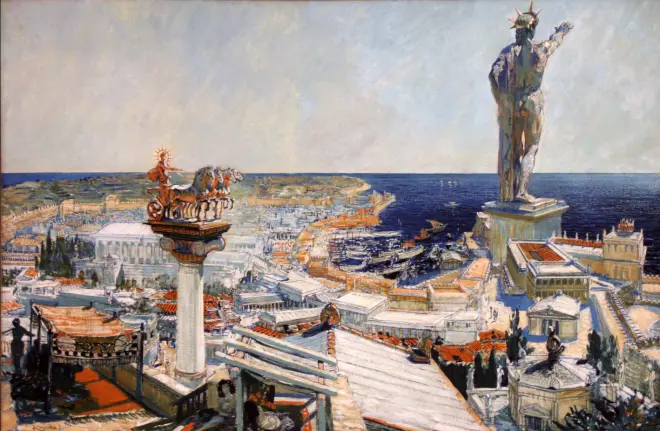
四、罗得岛太阳神铜像
1.Rhodes is an island in the sea. It had been hidden below the sea for a long time, but then Helios revealed it, and requested of the gods that the new island be his own. On this island stands a Colossus, one hundred and twenty feet high and representing Helios. The statue is recognizable as being of Helios because it has his distinctive features. The artist used a quantity of bronze that might have exhausted the mines, for the molten image of the structure was the bronze work of the world.
1. 罗德岛是一座海岛。它在海下隐藏了很久,后来赫利俄斯将它显露出来,并向众神祈祷新岛将属于自己。岛上矗立着一座巨像,高36米(120英尺),代表赫利俄斯。这座雕像具有赫利俄斯的显著特征,因此可以辨认出是赫利俄斯的雕像。建造者们使用的青铜数量可能已经耗尽了矿山,因为该结构的铸造雕像是世界上独一无二的青铜雕像。
2.Perhaps Zeus poured down marvelous wealth on the Rhodians precisely so that they could honor Helios in spending it on the erection of the statue of the god, layer upon layer, from the ground up to the heavens. The artist secured it firmly from the inside with iron frames and squared blocks of stone, of which the horizontal bars exhibit hammer work in the Cyclopean fashion. The hidden part of the work is bigger than the visible parts. Further questions strike the admiring spectator: what kind of fire tongs were used, what size were the bases of the anvils, with what workforce was such a weight of poles forged?
2. 也许是宙斯向罗得岛人倾泻了海量财富,正是为了让他们能够把这些财富用来为赫利俄斯铸造神像,一层一层,从地面一直建到天上。工匠们用铁架和方形石块从内部将神像牢牢固定住,其中的横条展示了巨石砌体。作品的隐藏部分比可见部分更大。欣赏者会产生更多的疑问:建造过程中使用的是什么类型的火炉钳,铁砧的底座有多大,如此重的杆子是用什么工具锻造的?
3.A base of white marble was laid down, and on this he first set the feet of the Colossus up to the ankle bones. He had already conceived in his mind the proportions in which the one-hundred-and-twenty-foot god was going to be built. Since the soles of the feet on the base were already at a greater height than other statues, it was impossible to lift up the rest and set it on top. The ankles had to be cast on top and, just as happens in building houses, the whole work had to rise on top of itself.
3. 雕像被放置在一个白色大理石底座上,工匠们首先在上面安放巨像的双脚,直至踝骨。他们已经在脑海中构思好了这尊一百二十英尺高的巨像的比例。由于底座上的脚底已经比其他雕像高,所以不可能把剩下的部分抬起来放在上面。脚踝必须铸在上面,就像盖房子一样,整个工程必须自上而下。
4.And for this reason, in the case of other statues, artists first make a mold, then divide it into parts, cast them, and finally put them all together and erect the statue. But the artist of the Colossus cast the first part and then molded the second part on the first and, when the second part had been cast in bronze, built the third part on top of that. He used the same method of construction for the remaining parts. For it was not possible to move the metal parts.
4.在其他雕像的制作过程中,艺术家们都是先制作一个模子,然后将其分成几个部分,再进行浇铸,最后将它们组合在一起并竖立起来。但巨像的建造者是先铸造第一部分,然后在第一部分上铸造第二部分,当第二部分固定后,再在其上建造第三部分。他们用同样的方法建造了其余部分。因为金属部件是无法移动的。
5.When the casting had been done on the earlier worked parts, the intervals of the bars and the joints of the framework were taken care of, and the structure was held steady with stones that had been put inside. So that throughout the construction he might retain his conception unshaken, he continually poured an immense mound of earth round the finished parts of the Colossus, hiding what had already been worked on underground, and carried out the next stage of casting on the flat surface of what was underneath.
5. 当前面的部分已经浇铸完毕后,就开始处理金属棒料的间距与框架的接缝,整体结构与内部放置的石头保持平衡。为了在整个施工过程中不动摇原先的构想,工匠们不断地在巨像已完工的部分周围堆起一个巨大的土堆,将已完成的部分隐藏在地下,然后在新的平面上进行下一阶段的浇筑。
6.Little by little he reached the goal of his dream and, at the expense of five hundred bronze talents and three hundred silver talents, he made his god equal to the god. He produced a work outstanding in its boldness, for on the world he set a second Helios facing the first.
6. 在五百名青铜工匠和三百名银匠的参与下,雕像逐渐呈现出理想中的模样。罗得岛人让自己的神与天神平起平坐。太阳神铜像的建造大胆出众,因为他们在世界上树立了第二个“赫利俄斯”,与第一个赫利俄斯遥遥相对。

五、巴比伦的城墙
1.Semiramis was rich in royal inventiveness. So when she died, she left a treasure of a wonder behind: she laid down foundations forty-one miles long and walled Babylon. The perimeter wall is long enough to exhaust a long-distance runner. The wall is striking not only on account of its length, but also on account of the solidity of its structure and of the width of the recesses inside it. For it is built from baked brick and bitumen.
1. 塞弥拉弥斯(Semiramis,传说中的亚述女王)富有皇家创造力。因此,当她去世时,留下了一个奇迹般的宝藏:在她任期内,人们修建了长达66公里(41英里)的地基,筑起了巴比伦城墙。城墙长度足以让一个长跑运动员筋疲力尽。这堵墙之所以引人注目,不仅因为其长度,还因其结构的坚固性和内部围墙的宽度。城墙是用烧砖和沥青砌成的。
2.The wall is more than eighty feet high and four four-horsed chariots can simultaneously ride along the width of the circular track [on top]. There are consecutive multi-storied towers [along the wall] which are capable of housing a whole army. The city is, thus, the advanced fortification of Persia. From the outside you would not guess that it encloses within itself a habitation.
2. 城墙高超过24米(80英尺),在(顶部)环形轨道的宽度上可以同时并排驾驶四辆四马战车。(沿着城墙的整个长度)多层塔楼依次升起,可以容纳整支军队。因此,这座城市是波斯最先进的防御工事。从外面看,你根本无法想象它的内部是居住区。
3.Thousands and thousands of men live inside the city's round wall! The size of the land outside the walls which is farmed is hardly bigger than the built-up area in Babylon, and the farmers outside the walls are as foreigners to those people living within the wall.
3. 成千上万的人住在城墙内!城墙外专门用于农业的土地面积仅比内部建筑面积大一点,墙外的农民对于居住在城墙内的人来说就像是外邦人一样。

六、以弗所的阿耳忒弥斯神庙
The Temple of Artemis at Ephesus is the only house of the gods. Whoever looks will be convinced that a change of place has occurred: that the heavenly world of immortality has been placed on the earth. For the Giants, or the sons of Aloeus, who attempted an ascent to heaven, made a heap out of mountains and built not a temple but Olympus. The result is that the work exceeds the enterprise in boldness and, likewise, the skill exceeds the work.
以弗所的阿耳忒弥斯神庙是众神的唯一居所。任何人看到都会确信这里发生了变化:天上的不朽世界被置于地上。对于试图升入天堂的巨人或者阿洛俄斯(Aloeus)的儿子来说,他们创造了山脉,但并没有建造神庙,而是建造了奥林匹斯山。其结果是,当能力超过野心,或者野心超过能力时,成功的可能性就变得有限了。
The architect loosened the bottom of the underlying ground, then dug out trenches to a great depth and laid down the foundations underground. The quantity of masonry expended on the structures below the ground amounted to whole quarries of mountains. He ensured its unshakeable steadiness and, having previously set Atlas under the weight of the parts that would support the building, first he set down on the outside a base with ten steps, and on that base he raised… [Here the manuscript breaks off; the rest of the piece is lost].
建筑师先松动地基底部,然后挖出很深的壕沟,在地下打下地基。地下部分所使用的砖石数量相当于整座采石场。为了确保地基的稳固性,工匠们事先在阿特拉斯(希腊神话里的擎天神,属于泰坦神族,被宙斯降罪来用双肩支撑苍天)上设置了支撑建筑的重物,在外侧建造了带有十级台阶的基座,然后在基座上抬起.......(手稿在此中断,其余部分已丢失)。

参考书目:
Auden, W. H. The Portable Greek Reader. Penguin Classics, 2000.
Dalley, S. The City of Babylon: A History, c. 2000 BC-AD 116. Cambridge University Press, 2021.
Elfinspell: Bede, Of the Seven Wonders of the World from The Biographical Writings and Letters of Venerable Bede, translated from the Latin by J. A. Giles, translatorAccessed 14 Jul 2023.
Jordan, P. Seven Wonders of the Ancient World. Longman, 2002.
Philo of Byzantium, On the Seven Wonders of the World: An English translation and some notes – Roger PearseAccessed 14 Jul 2023.
Romer, J. & E. The Seven Wonders of the World: A History of the Modern Imagination. Cassell PLC, 2001.

原文作者:Joshua J. Mark
曾在纽约马里斯特学院兼职担任哲学教授,曾在希腊和德国生活,并游历过埃及。曾在大学教授历史、写作、文学和哲学。

原文网址: https://www.worldhistory.org/article/2257/philo-of-byzantiums-on-the-seven-wonders/
封面:空中花园(艺术家印象)游戏《旧世界》
