
ExoMars火星车着陆点公布

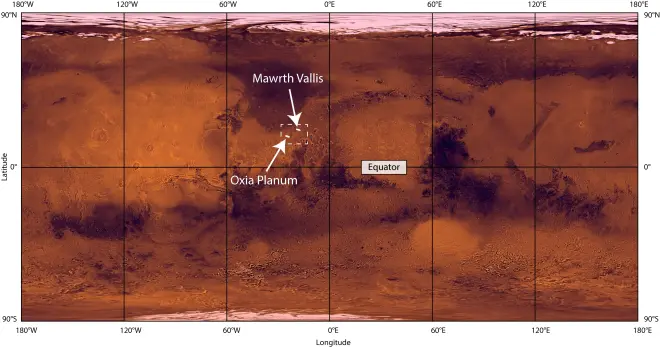
当ExoMars 2020降落在火星表面时,它着陆的地点很有可能会是Oxia Planum。日前,ExoMars着陆点选择工作小组宣布,这个位于火星赤道附近的区域被推荐为ExoMars 2020着陆点。除了Oxia Planum,Mawrth Vallis则曾是另外一个被考虑的对象。两个地方只相差几百公里,它们都位于赤道以北的同一区域,所在地高度约在火星“海平面”下3000米处。
根据ESA的说法,这个点将可以帮助他们追溯到火星表面液态水存在的年代–大约在40亿年前。那里拥有火星已知最丰富的粘土矿床之一,另外还有大量从南部高地到北部低地的通道–暴露了一些古老而有有趣的地质矿床。
这一点显得尤为重要,因为无人驾驶的ExoMars的主要任务是在火星展开自NASA在上世纪70年代展开Viking任务后首次寻找直接生命迹象的科研工作。这意味着工作小组需要在最近在英国莱斯特国家航天中心举行的为期两天的会议上找到能在科学、工程和技术要求之间寻找到最佳平衡点的着陆点。
工作小组必须要找到一个拥有足够低的着陆点,因为这样探测器的降落伞才能拥有足够的气体供其降落、保证着陆区不会出现任何的障碍物、探测器驾驶范围内不会有太多陡峭的斜坡或松软的碎片。ESA表示,Oxia Planum通过其粘土矿床、潮湿的远古历史以及最新暴露的矿床来满足这些要求以此来保护其不会受到侵蚀和空间辐射带来的影响。
ESA的ExoMars 2020项目科学家Jorge Vago表示,虽然Mawarth Vallis从科学角度考虑是一个独特的地点,但Oxia Planum为探测器进入、降落和着陆以及穿越地形抵达已经在轨道上识别出的科学点提供了额外的安全空间。
ExoMars 2020计划于2020年7月25日至8月13日在哈萨克斯坦拜科努尔发射基地搭乘Proton-M火箭升空,预计2021年3月19日登陆火星。而与此同时,ESA和Roscosmos(俄罗斯航天局)将在明年年中对最新的这个着陆点进行内部审查并对其进行正式确认。(中文新闻来源:网易新闻)


ESA官网原文:
The ExoMars Landing Site Selection Working Group has recommended Oxia Planum as the landing site for the ESA-Roscosmos rover and surface science platform that will launch to the Red Planet in 2020.
The proposal will be reviewed internally by ESA and Roscosmos with an official confirmation expected mid-2019.
At the heart of the ExoMars programme is the quest to determine if life has ever existed on Mars, a planet that has clearly hosted water in the past, but has a dry surface exposed to harsh radiation today.
While the ExoMars Trace Gas Orbiter, launched in 2016, began its science mission earlier this year to search for tiny amounts of gases in the atmosphere that might be linked to biological or geological activity, the rover will drive to different locations and drill down to two metres below the surface in search of clues for past life preserved underground. It will relay its data to Earth through the Trace Gas Orbiter.
Both landing site candidates – Oxia Planum and Mawrth Vallis – preserve a rich record of geological history from the planet’s wetter past, approximately four billion years ago. They lie just north of the equator, with several hundred kilometres between them, in an area of the planet with many channels cutting through from the southern highlands to the northern lowlands. Since life as we know it on Earth requires liquid water, locations like these include many prime targets to search for clues that may help reveal the presence of past life on Mars.
“With ExoMars we are on a quest to find biosignatures. While both sites offer valuable scientific opportunities to explore ancient water-rich environments that could have been colonised by micro-organisms, Oxia Planum received the majority of votes,” says ESA’s ExoMars 2020 project scientist Jorge Vago.
“An impressive amount of work has gone into characterising the proposed sites, demonstrating that they meet the scientific requirements for the goals of the ExoMars mission. Mawrth Vallis is a scientifically unique site, but Oxia Planum offers an additional safety margin for entry, descent and landing, and for traversing the terrain to reach the scientifically interesting sites that have been identified from orbit.”
The Landing Site Selection Working Group also emphasised that the discoveries generated during the landing site selection process are essential to guide the science operations of the ExoMars rover.
The recommendation was made today following a two-day meeting held at the National Space Centre in Leicester, UK, which saw experts from the Mars science community, industry, and ExoMars project present and discuss the scientific merits of the sites alongside the engineering and technical constraints.
The quest to find the perfect landing site began almost five years ago, in December 2013, when the science community was asked to propose candidate locations. Eight proposals were considered in the following April, with four put forward for detailed analysis in late 2014. In October 2015, Oxia Planum was identified as one of the most compatible sites with the mission requirements – at that time with a 2018 launch date in mind – with a second option to be selected from Aram Dorsum and Mawrth Vallis. In March 2017, the down-selection identified Oxia Planum and Mawrth Vallis as the two candidates for the 2020 mission, with both undergoing a detailed evaluation over the last 18 months.
On the technical side, the landing site must be at a suitably low elevation level, so that there is sufficient atmosphere and time to help slow the landing module’s parachute descent. Then, the 120 x 19 km landing ellipses should not contain features that could endanger the landing, the deployment of the surface platform ramps for the rover to exit, and the subsequent driving of the rover. This means scrutinising the region for steep slopes, loose material and large rocks.
On the science side, the analysis had to identify sites where the rover could use its drill to retrieve samples from below the surface, and to define possible traverses it could make up to 5 km from its touchdown point in order to reach the maximum number of interesting locations.
Oxia Planum lies at the boundary where many channels emptied into the vast lowland plains. Observations from orbit show that the region exhibits layers of clay-rich minerals that were formed in wet conditions some four billion years ago, likely in a large body of standing water. The channels that transported material into the lower-elevation ‘sink’, where the landing ellipse is situated, cover an area of 212 000 square kilometres. Layers of material that have been recently exposed through erosion are accessible from any of the touchdown points, giving a window into the early history of this area.
The minerals in Oxia Planum are representative of those found in a wide area around the region and so would provide insight into the conditions experienced at a global scale, putting constraints on the climate and habitability potential of Mars in this period.
Diverse aqueous episodes were followed by late volcanic activity, covering over the clay-rich deposits. Some lava material has resisted erosion until today, so the underlying materials may only have been exposed recently, initially protecting them from space radiation and later making them accessible to the rover and its analytical tools.
The landing ellipse has low elevation and contains very few topographic obstacles or challenging slopes.
The ESA-led rover and Roscosmos-led surface science platform will launch in the 25 July–13 August 2020 launch window on a Proton-M rocket from Baikonur, Kazakhstan, and cruise to Mars in a carrier module containing a single descent module, arriving at Mars 19 March 2021.
The descent module will separate from the carrier shortly before reaching the martian atmosphere, and will use two large parachutes, along with thrusters and a damping system, to slow its descent to land on the Red Planet. While the rover will drive to different locations to analyse the surface and subsurface, the stationary platform will provide context imaging at the landing site, and long-term climate monitoring and atmospheric investigations.
The test campaign for preparing the rover for Mars is in full swing. The rover structural and thermal model test campaign has been successfully completed, and a six-week qualification test on the Analytical Laboratory Drawer – the onboard laboratory where the rover’s drill samples will be processed and analysed – is also nearing completion. The test included verifying the functionality of the sample processing mechanisms using Mars analogue samples under simulated Mars environment conditions – a low pressure, carbon dioxide atmosphere and a range of temperatures.
Tests to characterise the rover’s ability to tackle different types of terrain are also ongoing with the locomotion verification model. The delivery of flight hardware has also started, including the rover’s computer, battery and deployable mast, along with the majority of science instruments.
“Our ExoMars mission combines extreme performance with the novel design features of the rover, and we are looking forward to operating the first European mission on the surface of Mars,” says Francois Spoto, ExoMars Programme team leader.
“Landing on Mars has a long chain of risks, but thanks to the combined skills and expertise of European and Russian industries working with reliable technologies, we are focused on a safe landing.”
官网文章地址:
http://www.esa.int/Our_Activities/Space_Science/ExoMars/Oxia_Planum_favoured_for_ExoMars_surface_mission
